
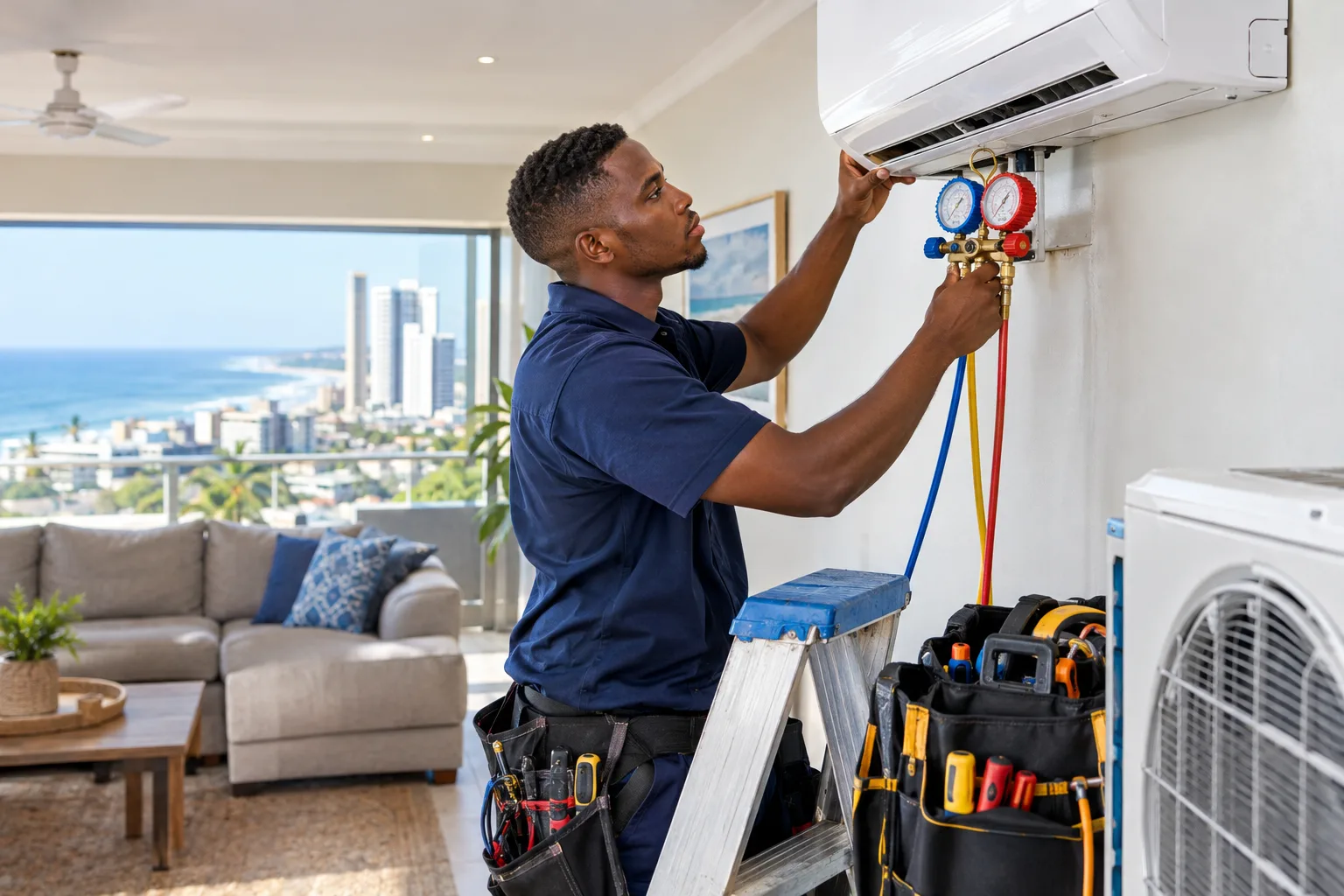
How to Start an Aircon Installation Business in South Africa (2026 Guide)
Air conditioning is one of the better trades to start a business in South Africa. Summers are getting hotter, more homes and offices are installing split units, and every unit you install needs servicing for years afterwards. That repeat work is what turns a one-person installer into a proper business.
This guide covers how to start an aircon installation business in South Africa in 2026: the registrations you need, what it costs to get going, the tools to buy, how to price your work and how to find your first customers. We build websites and run Google profiles for aircon companies, so the last part comes from what we see working.
The short answer: what do you need?
- The right registration to work with refrigerants. In South Africa that means registering with SAQCC Gas in the air conditioning and refrigeration category.
- A registered business with CIPC and SARS, plus UIF and COIDA once you employ anyone.
- Tools and transport. Expect roughly R30,000 to R80,000 for a proper starter tool kit, plus a bakkie or panel van if you don’t have one.
- Supplier accounts for units, copper pipe and refrigerant.
- A way for customers to find you: a Google Business Profile, reviews and a simple website.
| Starting as | Typical startup cost | What it covers |
|---|---|---|
| Solo installer with own vehicle | R40,000 – R100,000 | Registration, core tools, safety gear, insurance, first stock, basic marketing |
| Installer plus assistant | R80,000 – R180,000 | Second set of tools, ladders and access equipment, wages buffer, branded vehicle |
| Small commercial outfit | R200,000+ | Vehicle, recovery equipment for larger systems, more staff, compliance documents for tenders |
These are rough guides. Your biggest variables are whether you already own a vehicle and how much stock you buy up front. Most new installers buy units per job rather than holding stock.
Step 1: Get qualified and registered to handle refrigerants
This is the step that separates a legal aircon business from a “guy with a drill”. Working on air conditioning and refrigeration systems involves refrigerant gas under pressure, and South African regulations require the person doing that work to be qualified and registered.
SAQCC Gas registration
The South African Qualification and Certification Committee for Gas (SAQCC Gas) keeps the register of practitioners who may work on air conditioning and refrigeration systems. To register you need the relevant trade qualification or recognised training, and you register in the category that matches the work you do. You receive a card that customers, landlords and commercial clients can ask to see.
If you are not yet qualified, look for accredited air conditioning and refrigeration training through a recognised training provider, and confirm with SAQCC Gas which qualifications they accept before you pay for a course.
Electrical work
Most split units need an electrical connection and an isolator. In South Africa, electrical installation work must be done or supervised by a registered electrical contractor, who issues a Certificate of Compliance where required. Either get the electrical side qualified yourself or partner with a registered electrician, and never leave a customer with unsafe wiring.
Refrigerant rules
Older refrigerants such as R22 are being phased out under international agreements, and newer systems use refrigerants such as R410A and R32. Never vent refrigerant into the air: recover it with proper equipment. It is a legal requirement and it is the kind of detail commercial clients check.
Industry association
Joining an industry body such as SARACCA (the South African Refrigeration and Air Conditioning Contractors Association) is optional, but it gives you access to training, technical updates and a logo that reassures customers.
Step 2: Register the business
Sole proprietor or company?
You can start as a sole proprietor under your own name. Many commercial clients, property managers and builders, however, will only contract with a registered company, so most installers register a (Pty) Ltd fairly early.
CIPC and SARS
Registering a private company through the CIPC’s online BizPortal costs around R175 including name reservation. The company is registered for income tax with SARS automatically. VAT registration becomes compulsory once your turnover passes R1 million in a 12-month period (check SARS for the current threshold), and you can register voluntarily from R50,000.
If you employ staff
- Register for UIF and PAYE with SARS.
- Register with the Compensation Fund (COIDA). Installers work at height and with power tools, so this matters, and commercial clients will ask for a letter of good standing.
- Pay at least the national minimum wage and use written employment contracts.
For corporate and government work
- Register on the Central Supplier Database (CSD), which is free and required to supply government.
- Get a B-BBEE affidavit. Businesses with turnover under R10 million qualify as Exempted Micro Enterprises and can use a sworn affidavit.
Step 3: Buy the right tools
Good tools pay for themselves in faster installs and fewer callbacks. A typical starter kit includes:
- Vacuum pump and micron gauge
- Digital manifold gauge set
- Refrigerant recovery machine and recovery cylinder
- Nitrogen cylinder and regulator for pressure testing
- Flaring tool, pipe cutters, benders and a torque wrench
- Core drill and bits for wall penetrations
- Leak detector
- Ladders, safety harness for work at height, and basic electrical test equipment
Buy quality on the tools that affect the install (vacuum pump, gauges, flaring tool) and save on the rest. Many installers start with a reliable used bakkie rather than a new vehicle.
Step 4: Get insurance
Public liability insurance covers you if you damage a customer’s property, for example a cracked wall, a water leak from a badly installed drain or a fall from a ladder onto someone’s car. Commercial clients will ask for it, and “fully insured” on your website wins domestic customers too. Insure your tools and vehicle as well: a stolen tool bag can stop your income for weeks.
Step 5: Set up supplier accounts
Open accounts with two or three air conditioning wholesalers in your area. Trade pricing, warranty support and the ability to collect a unit the same morning make a big difference to your margins and your speed. Ask each supplier about installer registration programmes: some brands require installers to be registered with them for the manufacturer’s warranty to apply.
Step 6: Price your work properly
New installers often undercharge to win work, then find there is nothing left after copper, brackets, trunking and travel. Build your price from:
- The unit, at your trade cost plus a margin.
- Materials: copper pipe per metre, insulation, brackets, trunking, drain pipe, isolator and cable.
- Labour, based on realistic hours for a standard back-to-back install, with extra for long pipe runs, high walls or difficult access.
- Travel for jobs outside your main area.
Publish a “standard installation from R…” price on your website and explain what counts as standard (for example, up to 3 metres of pipe). Customers like knowing roughly what to expect, and it filters out people who only want the cheapest option.
Sell the service plan
Every installation is a chance to sign a customer up for an annual or six-monthly service. Servicing work is steady, quick and fills quiet months in winter. A business with a few hundred units on service plans is far more stable than one living from install to install.
Step 7: Get your first customers
Set up your Google Business Profile
When someone’s aircon stops working in a heatwave, they search “aircon repairs near me” and phone one of the three businesses Google shows on the map. Create your free Google Business Profile, choose the right category, list your services and areas, and add photos of every install. Our Google Business Profile setup guide walks you through it.
Ask for reviews from day one
Your first ten reviews matter more than almost anything else you do. Ask every customer, send your review link on WhatsApp the same day and reply to every review.
Partner with builders, electricians and property managers
Builders and renovators need an aircon installer they can rely on, electricians get asked about aircons all the time, and managing agents look after dozens of units. A short meeting and a clear trade rate can bring regular work.
Get a simple website
A website with a page for installations, repairs, servicing and the brands you work with gives Google something to show for each search, and gives customers a place to check your registration and prices. See how we build websites for air conditioning companies, and once you are up and running, read our guide on how to get more aircon customers in South Africa.
Common mistakes to avoid
- Working without the right registration. It puts customers at risk and can void manufacturer warranties.
- Skipping the vacuum and pressure test to save time. It is the most common cause of early failures and callbacks.
- Undercharging for materials and travel. Itemise your costs before you quote.
- Not selling servicing. One-off installs leave you starting from zero every month.
- Relying only on word of mouth. It is great when it works, but a Google profile with reviews keeps the phone ringing when referrals slow down.
Frequently asked questions
Do I need to be registered to install aircons in South Africa?
Yes. Work on air conditioning and refrigeration systems must be done by a qualified person registered with SAQCC Gas in the appropriate category, and the electrical connection must comply with the electrical installation regulations.
How much does it cost to start an aircon business in South Africa?
Roughly R40,000 to R100,000 for a solo installer who already has a vehicle, covering tools, registration, insurance and basic marketing. Adding staff or a vehicle pushes it higher.
Can I start an aircon business without experience?
You can start the business side, but the installation work must be done by someone who is qualified and registered. Many owners start by working for an established installer while they complete their training.
Is an aircon business profitable in South Africa?
It can be, especially if you combine installations with service plans and repairs. Profit depends on pricing materials and travel properly and keeping your diary full in winter.
Where do aircon installers buy units?
From air conditioning wholesalers and brand distributors, on a trade account. Open accounts with two or three so you can compare prices and availability.
How do I get my first aircon customers?
Set up a Google Business Profile, ask every customer for a review, partner with builders, electricians and managing agents, and get a simple website with a page for each service.
Final thoughts
Starting an aircon business in South Africa takes proper training, the right registration and good tools, but the reward is a trade with strong demand and years of repeat servicing work from every customer. Get the compliance right first, price properly, and make sure customers can find you when the heat arrives.
When you are ready to be found online, The Webster builds websites for aircon businesses from R250 a month with no setup fee, and our Growth Pack manages your Google profile and reviews with a Top 3 in 90 days guarantee. Get in touch to talk it through.