How Much Do Facebook and Instagram Ads Cost in South Africa? (2026 Guide)
Almost every guide to Facebook and Instagram advertising costs is written for an American audience. You read that the average cost per click is “about a dollar twenty”, convert it in your head, budget accordingly — and then your campaign behaves nothing like the article said it would.
That is because South African ad costs are genuinely different. In 2025, the average Facebook cost per click in South Africa sat around $0.22, roughly 80% below the global average of $1.13. Cheaper traffic is good news. It also means every dollar-based benchmark you have read is wrong for your market, usually by a factor of five.
This guide gives you the actual numbers in rand: what Meta ads cost per impression, per click and per lead in South Africa, what a realistic monthly budget looks like for a small business, and the seven things that decide whether you land at the cheap end of those ranges or the expensive one.
The short answer: Meta ad costs in South Africa, 2026
If you want the numbers without the explanation, here they are.
| Metric | Typical South African range (2026) |
|---|---|
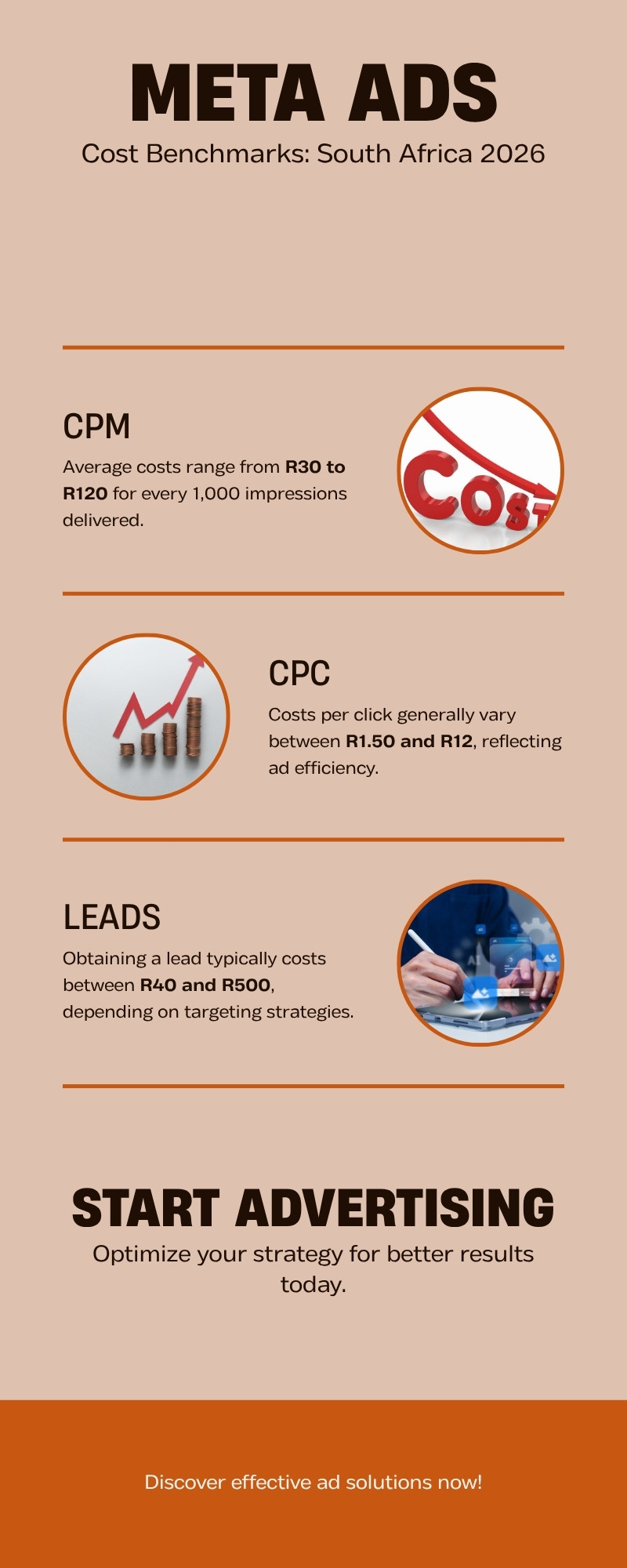
| CPM — cost per 1,000 impressions | R30 – R120 |
| CPC — cost per click (traffic campaigns) | R1.50 – R12 |
| CPC — cost per click (lead generation) | R25 – R90 |
| Cost per lead | R40 – R500 |
| Typical monthly ad spend, small business | R3,000 – R12,000 |
| Agency management fee (on top of spend) | R3,000 – R12,000 /month |
Those ranges are wide on purpose. A furniture retailer in Sandton and a plumber in Pinetown are buying completely different attention, and their costs reflect that. The rest of this article explains where in each range you are likely to land.
What you are actually paying for
Meta does not charge you a flat fee. You are bidding in a live auction against every other advertiser trying to reach the same person, and the price is set by three numbers.
CPM — cost per thousand impressions
CPM is what it costs to show your ad 1,000 times. In South Africa this usually lands between R30 and R120. It is the cleanest measure of how expensive an audience is, because it strips out whether anyone actually did anything.
CPM rises when your audience is small and specific. Targeting “business owners in Umhlanga, 35–55, interested in commercial property” costs far more per impression than targeting “adults in KwaZulu-Natal”, because you are competing with every other advertiser who wants that same narrow, valuable group.
CPC — cost per click
CPC is CPM divided by how many people actually clicked. For a straightforward traffic campaign, expect R1.50 to R12. For lead generation campaigns — where Meta optimises toward people likely to submit a form, not just click — expect R25 to R90.
That gap surprises people. A lead-gen click costs more because Meta is hunting for a much rarer type of person, so it has to show your ad to a more expensive slice of the audience.
Cost per lead
This is the number that actually matters, and the one to judge campaigns on. In South Africa a well-targeted campaign produces leads at R40 to R500.
The spread here is enormous because “a lead” means wildly different things. A newsletter signup might cost R40. A booked site inspection for a solar installation might cost R450 — and still be the cheaper of the two, because one of them turns into R85,000 of work.
Facebook or Instagram: which one costs more?
They are the same ad system — you buy both through Meta Ads Manager — but placement changes the price meaningfully.
Instagram Feed typically runs R55 – R110 CPM. It is the most competitive placement on the platform, because it is where most advertisers default to putting their budget.
Instagram Reels typically runs R30 – R65 CPM. Reels inventory has grown much faster than advertiser demand for it, and that imbalance keeps prices down. If your cost per impression matters more than polish, Reels is currently the best-value placement on Meta in South Africa.
Facebook Feed generally sits between the two, and skews cheaper for audiences over 40 — still a large, active and often underserved group in South Africa.
The practical takeaway: if you are running one creative across both platforms and wondering why costs are high, check your placement breakdown before you touch anything else. A lot of South African advertisers are paying Instagram Feed prices for results they could get on Reels for half.
What South African small businesses actually spend per month
Most South African small businesses run effective Meta campaigns on R3,000 to R12,000 per month in ad spend.
Below about R3,000 a month you run into a structural problem rather than a budget one. Meta’s algorithm needs roughly 50 conversion events per ad set per week to exit the “learning phase” and optimise properly. At R1,000 a month with a R200 cost per lead, you are generating five leads a month. The algorithm never gets enough data to learn, so it never gets efficient, and you conclude that Meta ads do not work — when what actually happened is that you never gave the system enough signal to work with.
A realistic starting point is around R6,000 per month, committed for at least three months. The first month is largely data collection. Months two and three are where the cost per lead usually drops as the targeting sharpens.
Then there is management. A South African agency will typically charge R3,000 to R12,000 per month to run campaigns, on top of what you spend on the ads themselves. Anyone charging meaningfully less than that is either running your account on autopilot or has a volume model that does not include looking at your campaigns very often.
Seven things that change what you pay
1. Audience size
Narrow audiences cost more per impression. Broad audiences cost less but waste more. In smaller South African markets, over-targeting is the most common and most expensive mistake — there simply are not enough people in “plumbers’ customers in Ballito aged 30–45” to sustain a campaign.
2. Campaign objective
Awareness is cheapest, traffic sits in the middle, conversions and lead generation cost the most. You are paying Meta to find progressively rarer behaviour.
3. Creative quality
This has the single biggest effect and costs nothing to fix. Meta rewards ads people engage with by charging less to show them. A genuinely good ad can cost half what a mediocre one costs for identical targeting — the auction quietly subsidises advertisers who do not annoy users.
4. Industry
Competitive, high-value sectors pay more. Financial services, legal, property and insurance sit at the top. Local trades and home services sit considerably lower.
5. Seasonality
Costs climb sharply in November. Black Friday and the festive season pull enormous retail budgets into the auction, and everyone pays more — including you, even if you sell something entirely unrelated to retail. Budget for a 30–50% CPM increase in November and plan campaigns around it.
6. Ad frequency
Once the same person has seen your ad six or seven times, performance falls off and costs rise. If your cost per lead is creeping up week over week with nothing else changed, check your frequency metric first.
7. Where the click lands
Meta charges you for the click. Your website decides whether it was worth anything. If your landing page is slow, unclear or not built for mobile, you pay full price for traffic that leaves immediately. A slow site is an advertising cost, not just a web problem — and it is why a website that does not convert quietly doubles your real cost per customer.
Is it actually worth it? Do the maths
Cost per lead means nothing on its own. What matters is what a customer is worth to you.
Take a plumber running a R6,000 monthly budget at a R150 cost per lead. That produces 40 leads a month. Say a third of them become paying jobs — 13 jobs. If the average job is R2,500, that is R32,500 in revenue from R6,000 in ad spend.
Now run the same maths for a business where the average sale is R400 and the close rate is 10%. Forty leads become four customers and R1,600 in revenue against R6,000 in spend. Same campaign performance. Completely different outcome.
Before you spend anything, work out two numbers: what an average customer is worth to you, and what percentage of leads you actually close. If you do not know them, that is the thing to fix first — not your targeting.
How to bring your cost per lead down
- Fix the creative before the targeting. It is free, and it moves costs more than any audience change.
- Test Reels placements. Often half the CPM of Instagram Feed for the same audience.
- Give the algorithm room. Fewer ad sets with more budget each beats many ad sets split thin.
- Let campaigns run. Resist editing during the learning phase; every significant edit restarts it.
- Exclude existing customers. Stop paying to advertise to people who have already bought.
- Send traffic to a page built to convert, not your homepage. One offer, one form, fast on mobile.
- Watch frequency and refresh creative when it climbs above 3–4.
Facebook ads or Google Ads?
They solve different problems. Google Ads captures people already searching for what you sell — high intent, higher cost per click. Meta ads create demand among people who were not looking but fit the profile — lower intent, much cheaper reach.
For most South African small businesses the honest answer is that Google Ads is the better first rand if people actively search for your service, and Meta is the better first rand if they do not. We broke that decision down properly in Facebook Ads vs Google Ads: which is better for South African small businesses.
Frequently asked questions
How much do Instagram ads cost in South Africa?
Instagram ads in South Africa cost roughly R30 to R120 per thousand impressions, with Instagram Feed (R55–R110 CPM) costing noticeably more than Reels (R30–R65 CPM). Cost per lead typically falls between R40 and R500.
What is the minimum budget for Facebook ads in South Africa?
Meta allows daily budgets from around R20, but campaigns below roughly R3,000 per month rarely generate enough conversion data for the algorithm to optimise. R6,000 per month for at least three months is a realistic starting point.
Are Facebook ads cheaper in South Africa than overseas?
Yes, substantially. South African cost per click averaged about $0.22 in 2025 against a global average of $1.13 — roughly 80% cheaper. Lower competition in the local auction is the main reason.
How much should I pay an agency to manage my Meta ads?
South African agencies typically charge R3,000 to R12,000 per month, separate from your ad spend. Some charge a percentage of spend instead, usually 10–20%.
Why did my cost per lead suddenly increase?
The most common causes are ad fatigue (check your frequency metric), seasonal auction pressure (November especially), an edit that restarted the learning phase, or an audience that has been saturated.
The bottom line
Meta advertising in South Africa is cheap by global standards and genuinely effective — but only when the numbers are set up to work. Budget around R6,000 a month, commit to three months, put real effort into the creative, and send the clicks to a page actually built to convert them.
That last part is where most campaigns quietly fail. You can buy the cheapest clicks in the country and still lose money if they land on a website that does not sell.
If you want someone to handle it properly, we run Facebook and Instagram ad campaigns for South African businesses from R750 — and we will tell you honestly if we think Google Ads would serve you better. Get in touch for a straight answer on what your budget can realistically achieve.