
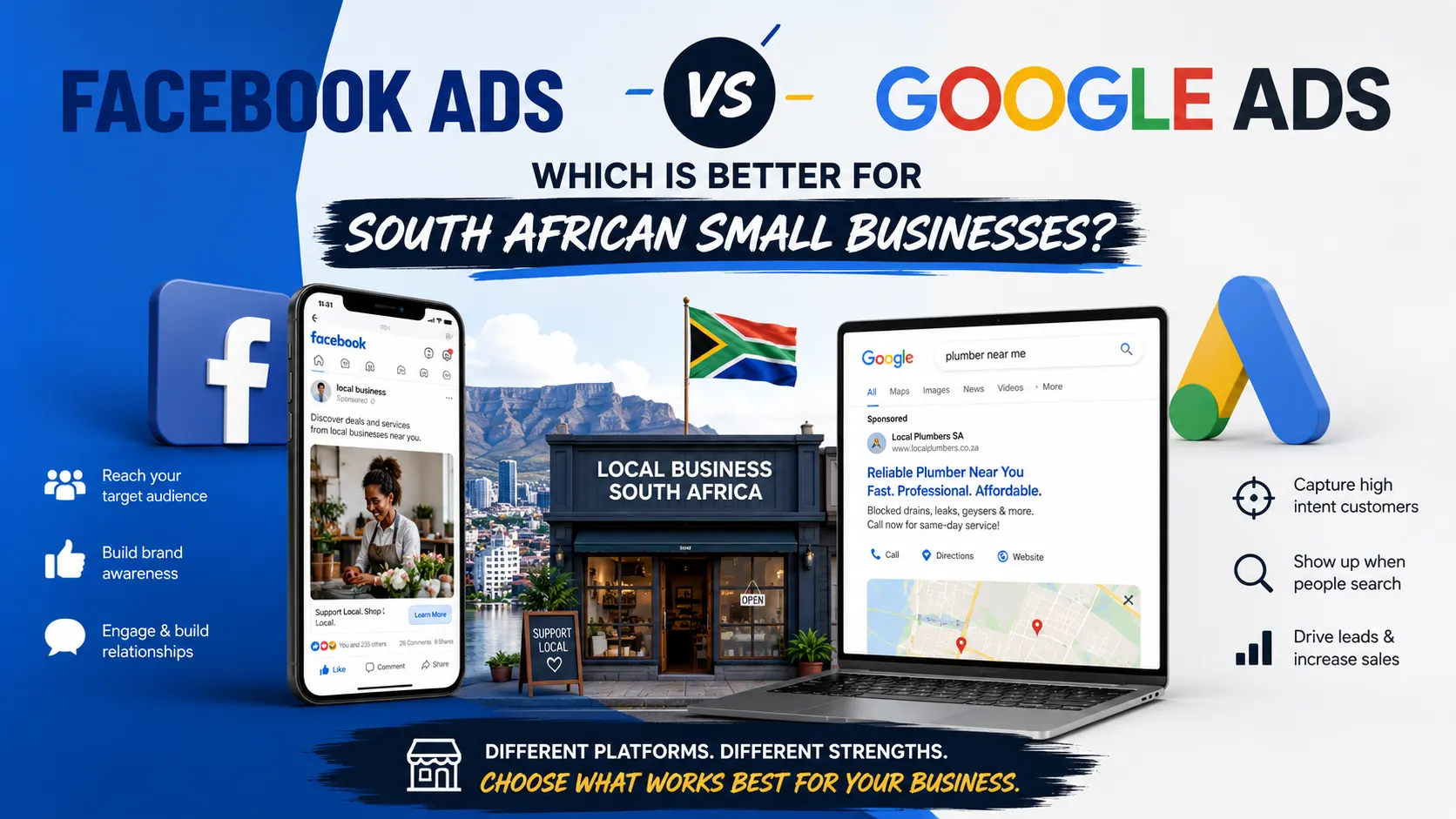
Facebook Ads vs Google Ads — Which Is Better for South African Small Businesses?
If you’ve ever tried to figure out where to spend your limited advertising budget as a South African small business, you’ve probably asked yourself this exact question. Facebook Ads and Google Ads are the two most powerful digital advertising platforms available to small businesses — but they work very differently. This guide breaks down exactly how each one works, what they cost in South Africa, which businesses benefit most from each and ultimately which one you should choose given your goals and budget.
Table of Contents
- How Facebook Ads and Google Ads Work
- What Do They Cost in South Africa?
- Audience Targeting — Who Can You Reach?
- Search Intent vs Interruption Marketing
- When Facebook Ads Work Better
- When Google Ads Work Better
- Side-by-Side Comparison
- The Verdict for South African Small Businesses
- Should You Use Both?
1. How Facebook Ads and Google Ads Work
Before you can decide which platform is better for your business, you need to understand the fundamental difference in how each one works — because they are built on completely different principles.
How Google Ads Works
Google Ads is a search-based advertising platform. When someone types a search query into Google — for example “web designer in Durban” or “plumber near me” — Google shows a list of results. The ads that appear at the top of those results are Google Ads. You bid on specific keywords, and when someone searches for those keywords, your ad has a chance of appearing.
The critical thing to understand about Google Ads is that it captures demand that already exists. The person searching for a plumber is actively looking for a plumber right now. They have a problem and they want a solution immediately. Google Ads puts your business in front of them at precisely that moment.
How Facebook Ads Works
Facebook Ads — which also covers Instagram since both are owned by Meta — is an interruption-based advertising platform. Your ads appear in people’s social media feeds while they are scrolling through posts from friends, family and pages they follow. Unlike Google, these people are not actively searching for your product or service. They may not even know they need it yet.
Facebook Ads works by targeting people based on who they are — their age, location, interests, behaviour and life events — rather than what they are searching for. You are showing your ad to people who match the profile of your ideal customer, regardless of whether they are actively looking to buy.
The simplest way to remember the difference: Google Ads finds people who are actively looking for what you sell. Facebook Ads finds people who match the profile of someone who might want what you sell.
2. What Do They Cost in South Africa?
Cost is one of the first things South African small business owners ask about — and rightfully so. When you’re running a small business with a tight budget, every rand needs to work hard.
Google Ads Costs in South Africa
Google Ads uses a pay-per-click (PPC) model, which means you only pay when someone actually clicks on your ad. The cost per click varies significantly depending on your industry and the keywords you’re bidding on.
In South Africa, the average cost per click on Google Ads ranges from R2 to R30 for most small business industries. Highly competitive industries like legal services, financial services and medical practices can see costs of R50 to R150 per click or more. Less competitive local service industries — like cleaning companies, tutors and small tradespeople — often see costs of R3 to R10 per click.
For most South African small businesses, a minimum budget of R500 per month in ad spend is recommended to see meaningful results. R1,000 to R2,000 per month is where most small businesses start seeing consistent leads and enquiries.
Facebook Ads Costs in South Africa
Facebook Ads typically costs less per click than Google Ads for most industries in South Africa. The average cost per click on Facebook in South Africa ranges from R1 to R8 for most small business categories. This makes Facebook Ads more accessible for businesses with very limited budgets.
However, the lower cost per click doesn’t always mean better value. A cheaper click from someone who wasn’t looking for your product may convert at a much lower rate than a more expensive click from someone actively searching on Google. Value is measured in cost per conversion — not cost per click.
Important: On both platforms, your ad budget is paid directly to Google or Meta — not to any agency or service provider. The Webster’s setup and management fees are completely separate from your ad spend.
3. Audience Targeting — Who Can You Reach?
Both platforms offer powerful targeting capabilities, but they work in fundamentally different ways.
Google Ads Targeting
Google Ads targeting is primarily keyword-based. You choose the search terms you want to appear for and Google shows your ad when people search for those terms. You can also layer in additional targeting such as:
- Geographic location — show ads only to people in Durban, Johannesburg, Cape Town or specific areas
- Device type — mobile, desktop or tablet
- Time of day — show ads only during business hours
- Audience demographics — age, gender and household income
- Remarketing — show ads to people who have previously visited your website
Facebook Ads Targeting
Facebook Ads targeting is audience-based and is arguably the most sophisticated of any advertising platform in the world. You can target people based on:
- Location — country, province, city or a radius around a specific address
- Age and gender
- Interests — pages they follow, topics they engage with, hobbies
- Behaviour — recent purchase behaviour, device usage, travel habits
- Life events — recently moved, recently engaged, new parents
- Custom audiences — people who have visited your website, your customer list or video viewers
- Lookalike audiences — people who share characteristics with your existing customers
This depth of targeting makes Facebook Ads exceptionally powerful for reaching very specific groups of people — even when those people don’t know they need your product yet.
4. Search Intent vs Interruption Marketing
This is arguably the most important concept to understand when choosing between the two platforms — and it directly affects which businesses should prioritise each one.
High Purchase Intent on Google
When someone searches “emergency plumber Durban” or “best accountant in Johannesburg” on Google, they are expressing high purchase intent. They have a need, they are ready to act and they are actively looking for a solution. This is the ideal moment to put your business in front of them.
Google Ads excels at capturing these high-intent moments. The conversion rates on Google Ads tend to be higher than Facebook because the person clicking your ad is already interested in what you sell — you just need to convince them to choose you over your competitors.
Building Awareness on Facebook
Facebook and Instagram users are in a completely different mindset when they encounter your ad. They are relaxing, catching up with friends or watching entertaining content. They are not in buying mode — at least not yet.
This means Facebook Ads requires more creative work to stop the scroll, capture attention and build enough interest for someone to take action. The upside is that Facebook allows you to reach people before they even know they want your product — which is especially powerful for businesses selling products or services that people don’t search for proactively.
5. When Facebook Ads Work Better
Facebook Ads tends to outperform Google Ads in the following situations:
Visual Products and Services
If what you sell looks good, Facebook and Instagram ads are extremely powerful. Fashion, food, beauty products, home décor, events and anything with strong visual appeal performs exceptionally well on social media. A stunning image or short video of your product can stop the scroll and drive significant sales.
Building Brand Awareness
If your goal is to get your brand name known in your local area or industry, Facebook Ads is more effective. You can reach thousands of people in your target market for a relatively small budget — building recognition over time even before they’re ready to buy.
Impulse Purchases and Low-Consideration Products
Products that people buy on impulse — affordable clothing, food, entertainment, beauty treatments — perform well on Facebook because the low price point and strong visual can trigger an immediate purchase decision without much research.
Reaching a Very Specific Audience
If your ideal customer is a very specific type of person — for example, “women between 25 and 45 in Sandton who are interested in fitness and wellness” — Facebook’s targeting capabilities make it far easier to reach exactly that person than Google does.
Retargeting Website Visitors
One of the most powerful uses of Facebook Ads is retargeting — showing ads to people who have already visited your website. These people already know about your business but didn’t convert. A well-timed Facebook ad reminding them of what they looked at can bring them back to complete the purchase.
6. When Google Ads Work Better
Google Ads tends to outperform Facebook Ads in the following situations:
Service-Based Businesses With High Purchase Intent
Plumbers, electricians, lawyers, accountants, web designers, cleaning companies, mechanics — any business where people search Google when they have an urgent need. These searches have high conversion rates because the person is ready to act immediately.
Local Businesses Targeting Specific Areas
If your business serves a specific geographic area — for example, a hair salon in Pretoria or a pest control company in Cape Town — Google Ads lets you show ads only to people searching from that area for your specific service. This makes your budget very focused and efficient.
High-Value Products and Services
When someone is making a significant purchase decision — a wedding venue, a car service, legal advice, a website — they typically do research on Google before committing. Being visible on Google at this research stage is critical for high-ticket services.
Capturing Competitors’ Customers
You can bid on competitor brand names as keywords on Google Ads. When someone searches for your competitor, your ad can appear — giving you the chance to offer them an alternative. This is a tactic that doesn’t exist on Facebook.
Fast Results When You Need Leads Now
If your business needs leads immediately — a new business launching, a seasonal promotion or filling a quiet period — Google Ads can start driving qualified traffic within hours of going live.
7. Side-by-Side Comparison
| Feature | Google Ads | Facebook Ads |
|---|---|---|
| How it works | Search-based — targets people actively searching | Interruption-based — targets people by profile |
| Average CPC in SA | R2 – R30+ | R1 – R8 |
| Purchase intent | High — people are actively looking | Lower — people are browsing |
| Visual creative required | Minimal — text-based ads | Yes — images and video perform best |
| Audience targeting depth | Good — keyword and demographic | Excellent — interest, behaviour, lookalike |
| Brand awareness | Limited | Very strong |
| Speed to results | Fast — same day in most cases | Fast but needs optimisation time |
| Best for | Service businesses, local search, high intent | Visual products, brand building, awareness |
| Min. recommended SA budget | R500 – R1,000/month | R500 – R1,000/month |
8. The Verdict for South African Small Businesses
Our Recommendation
It depends on your business — but here’s the simple answer
If people search Google for what you sell, start with Google Ads. If they don’t search for it but you can describe who your ideal customer is, start with Facebook Ads. If your budget allows, use both.
Here is a practical guide for South African small businesses based on business type:
Start with Google Ads if you are:
- A plumber, electrician, painter, builder or any trade service
- A lawyer, accountant, financial advisor or consultant
- A web designer, IT support company or digital agency
- A cleaning company, pest control service or gardening service
- A medical practice, dentist or physiotherapist
- Any business where customers search Google when they have an urgent need
Start with Facebook Ads if you are:
- A clothing boutique, beauty brand or fashion business
- A restaurant, café or food business
- A hair salon, nail salon or beauty therapist
- An events company, photographer or videographer
- A gym, personal trainer or wellness business
- Any business selling visual products or lifestyle services
Use both if you are:
- An e-commerce store selling physical products
- A real estate agent or property developer
- A school, training academy or educational institution
- Any business with a budget of R2,000 or more per month in ad spend
9. Should You Use Both Facebook Ads and Google Ads?
The most effective digital advertising strategies for South African small businesses use both platforms together — each doing what it does best.
A typical combined strategy might look like this:
- Google Ads captures people actively searching for your services and drives them to your website
- Facebook Retargeting Ads shows ads to those website visitors who didn’t convert — reminding them of your business and bringing them back
- Facebook Awareness Ads builds brand recognition in your local area so more people already know your name when they eventually search on Google
This combination turns both platforms into a coordinated system where each one feeds the other. However, this approach requires a larger budget. If you’re starting with R500 to R1,000 per month in ad spend, it’s better to focus on one platform first, learn what works and then expand.
The most important thing is to pick one platform, set it up correctly and give it enough time and budget to work. Too many South African small businesses split a tiny budget across both platforms, see mediocre results from each and conclude that digital advertising doesn’t work — when the real problem was an insufficient budget spread too thin.
The golden rule for South African small businesses: Start with the platform that matches your business type and customer behaviour. Master it. Then add the second platform once you’re seeing consistent results from the first.
How Much Should You Budget?
For South African small businesses just starting with digital advertising, a realistic starting budget is R500 to R1,000 per month in ad spend on a single platform. This gives Google or Meta’s algorithm enough data to optimise your campaign and gives you enough impressions to draw meaningful conclusions about what’s working.
With a well-set-up campaign and a R1,000/month budget on Google Ads, a local service business in South Africa can typically expect 30 to 100+ clicks per month depending on the industry and competition — which, at a 5 to 10% conversion rate, translates to 2 to 10 leads per month. As your budget grows and your campaign optimises, these numbers improve significantly.
Getting Your Campaigns Set Up Right
Both platforms reward well-structured, correctly configured campaigns. A poorly set-up Google Ads account can burn through budget targeting the wrong keywords. A Facebook campaign with the wrong objective selected will optimise for the wrong outcome entirely.
Most South African small business owners don’t have the time or expertise to manage these platforms effectively while also running their business — which is where professional setup and management makes a significant difference to your return on investment.
At The Webster, we offer affordable Google Ads setup and management from R950 once-off and Facebook and Instagram ad campaigns from R750 — giving South African small businesses access to professional digital advertising without agency price tags.
Final Thoughts
Facebook Ads and Google Ads are not competitors — they are complementary tools that work differently and serve different purposes. The question is never really “which is better” in absolute terms. The question is “which is better for my specific business, my specific customer and my specific goal right now?”
If people search Google for what you sell, Google Ads is your priority. If your product sells on visual appeal and social discovery, Facebook Ads is your starting point. And if your budget allows, a coordinated strategy using both platforms together is ultimately the most powerful approach to growing a South African small business through digital advertising.
Ready to Start Running Ads for Your South African Business?
We set up and manage Google Ads and Facebook & Instagram campaigns for South African small businesses at prices that actually make sense. Professional setup, no agency fees.